
Beads
A dependency-aware Beads work queue for each Paseo workspace.

Paseo Beads
A dependency-aware Beads work queue for every Paseo workspace. Paseo Beads turns active issues into a read-only delivery view that makes the ready frontier, work in progress, and blockers immediately visible.
It adds a workspace-scoped Beads Explorer panel and an Open Beads Command Center item. On Paseo 0.11 and newer it also adds a Ready beads sidebar row and a linkable bead screen.
Demo
https://github.com/user-attachments/assets/f85e3c94-fbc1-49b6-9439-25bb7f66e9d7
Screenshots
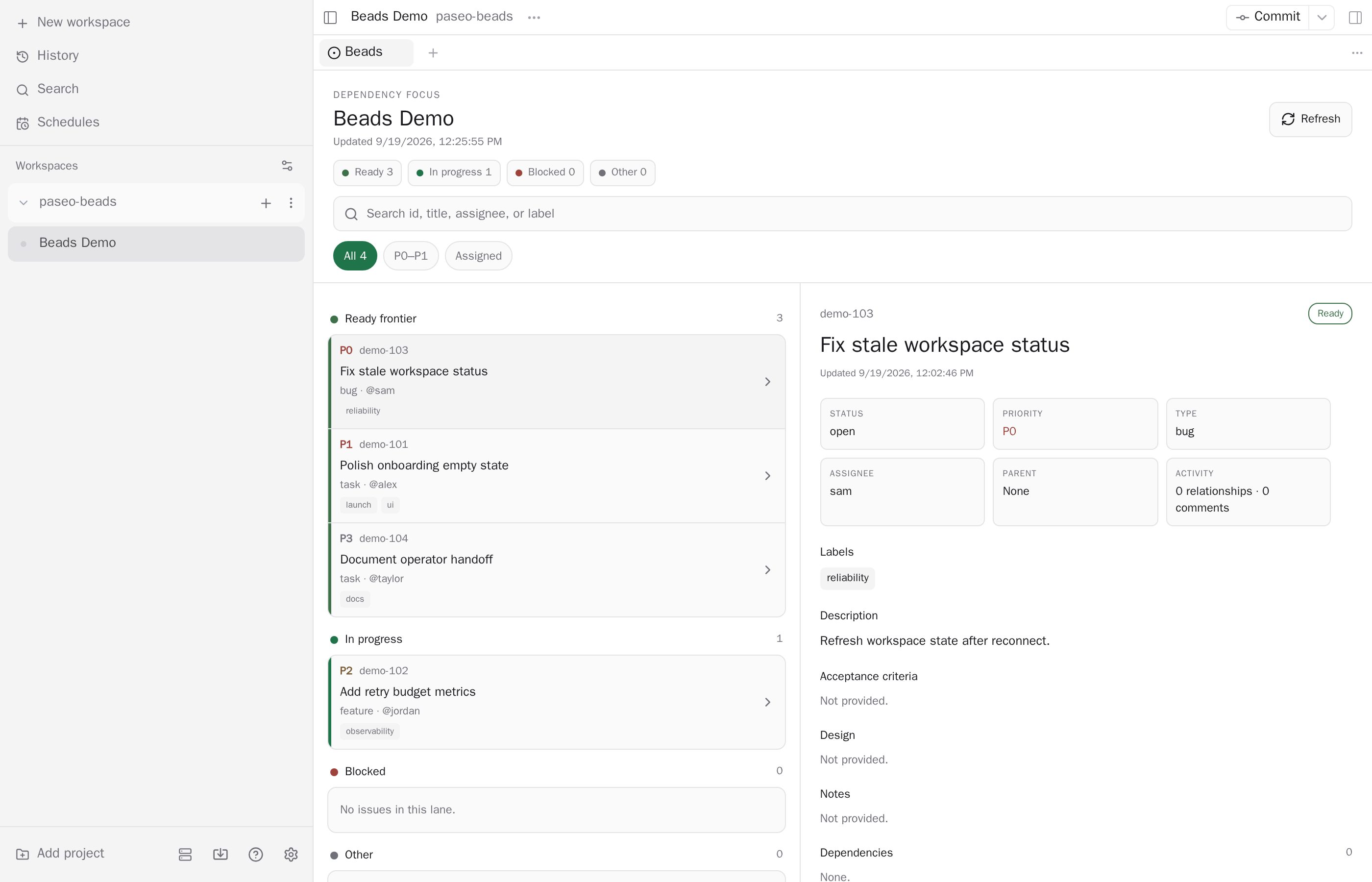
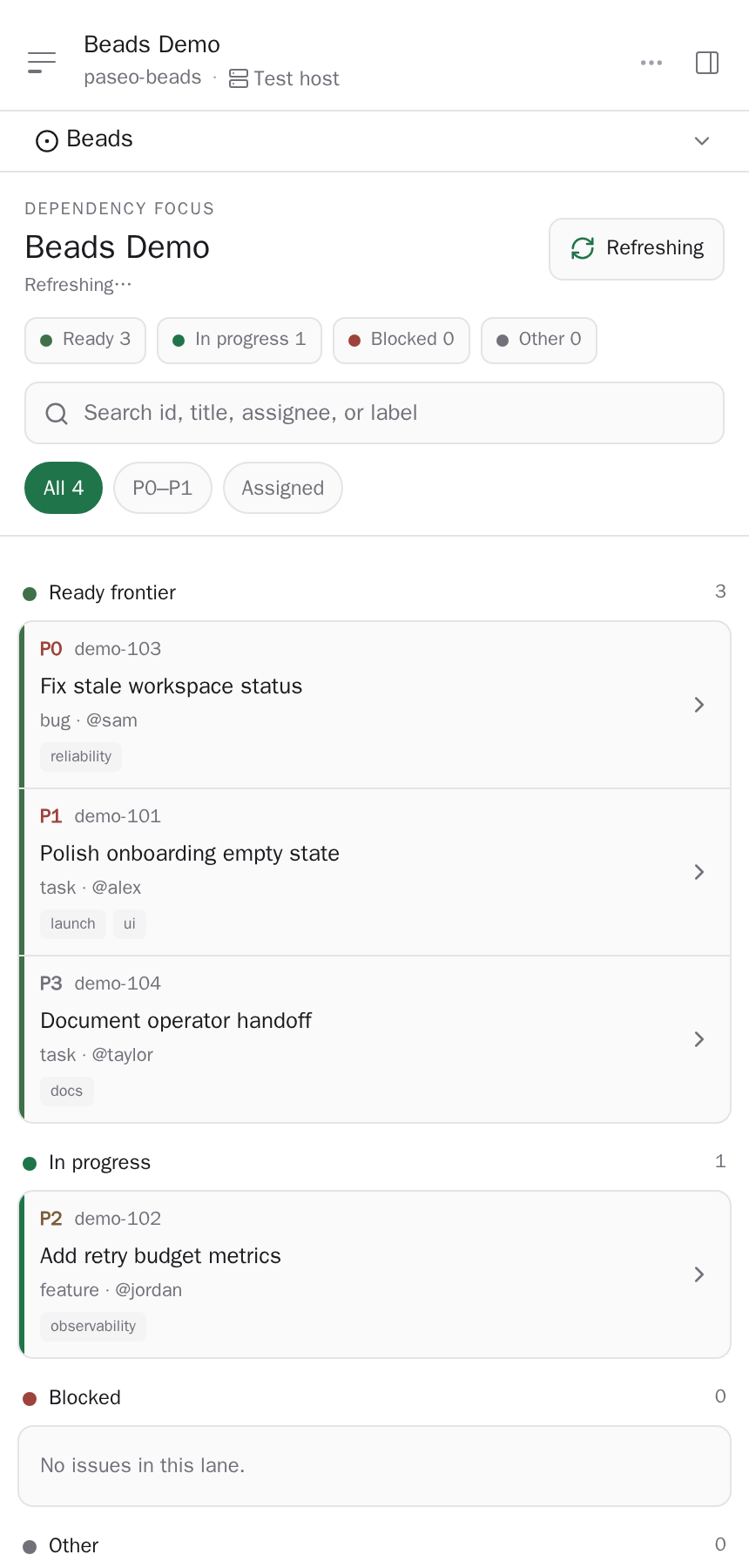
Issue IDs, titles, assignees, labels, and details come from a temporary synthetic Beads project. Both PNGs were captured from an isolated Paseo daemon at 2× pixel density after browser DevTools verified the rendered page contained no private organization names.
Wide
Compact
What it shows
- Active issues grouped into Ready frontier, In progress, Blocked, and Other lanes.
- Priority, issue ID, title, type, assignee, labels, and relationship and comment counts on each row.
- Lane totals, text search over ID, title, assignee, and labels, and All, P0–P1, and Assigned filters.
- A detail view with status, readiness, priority, type, assignee, parent, labels, description, acceptance criteria, design, notes, dependencies, dependents, and update time.
- A side-by-side list and detail view when space permits, with list/detail navigation in compact layouts.
- A virtualized issue list, descriptive accessibility labels, and focus restoration when navigating between the compact list and detail view.
- On Paseo 0.11 and newer, a Ready beads sidebar row with the number of ready beads across the host's workspaces. Pressing it opens a popover (a bottom sheet in compact layouts) with the top 10 ready beads grouped by workspace. Pressing a bead opens its detail view as a screen whose URL carries the workspace and bead IDs, so it can be linked and survives a reload.
Within each lane, issues are ordered by priority, most recent update, then ID. In-progress and hooked issues enter In progress first; remaining blocked issues enter Blocked; ready issues enter Ready frontier; all remaining active issues enter Other.
How it works
The panel calls workspace-scoped Paseo plugin RPC handlers. On the daemon host, each handler resolves
the workspace directory through Paseo and executes the bd CLI with --readonly and -C:
- The list handler runs
bd list --json --sort priority, then runs one authoritativebd list --ready --json --limit 0query and intersects its IDs with the displayed issues. It also runsbd where --jsonand returns a digest of the database location as an opaquedatabaseId, so workspaces that share one database, such as git worktrees, can be recognized. This is best effort: whenbdcannot say, the snapshot is the same without it. - Selecting an issue runs
bd show <issue-id> --json --include-dependentsplus the same authoritative readiness query.
The server validates and normalizes the CLI JSON before returning bounded data to the panel. The
plugin never reads or writes .beads storage directly and exposes no issue mutation controls.
The list and selected detail poll every 10 seconds. Refresh requests the list immediately. A failed background refresh keeps the previous data visible with an inline error; initial and detail failures provide a retry action.
The Ready beads row lists the host's workspaces through the Paseo SDK and calls the same list
handler for them, one workspace at a time, every 2 minutes while the app is in the foreground and
whenever its popover opens. A snapshot an open panel read in the last 10 seconds is reused instead
of rerunning bd. Workspaces that share a database, such as git worktrees, report the same
databaseId, so an issue counts once however many workspaces read it and is listed under the first
workspace that reported it. The first scan reads every workspace to learn which ones share a
database. Later scans read each database once and skip its other workspaces. A workspace is skipped
only while a successful read in the last 10 minutes vouches that it reads a database the scan has
already read, so a failed or older read puts it back in the scan. Workspaces without Beads count as
zero and are rechecked every 5 minutes. When bd is unavailable, or a workspace cannot be read,
the popover says so instead of reporting an empty host, and a failed refresh is shown next to the
last result. Once nothing shows the count, for example when the host disconnects, a scan that is
still running starts no further workspace reads.
Limits
- Paseo
^0.9.0 || ^0.10.0 || ^0.11.0with plugins enabled is required. - Beads
bd1.0 or newer must be available on the Paseo daemon'sPATH. - A Beads project must be initialized in the workspace for issue data to appear.
- CLI calls time out after 10 seconds and accept at most 8 MiB of output. Unexpected CLI details stay in Paseo plugin logs; the panel receives a stable, sanitized error message.
- At most 500 issues are displayed. When more exist, the panel warns that lane counts and local search results may be incomplete.
- The server rejects oversized IDs, titles, body fields, labels, relationships, comments, and readiness sets rather than transferring unbounded data to the client.
- Search and filters operate only on the displayed snapshot.
- The panel distinguishes an unavailable
bdbinary, an uninitialized Beads project, an empty project, request failures, and missing issue details. - This plugin is read-only and workspace-scoped. It uses the
bdCLI exclusively and does not create, edit, close, or assign issues. - The Ready beads row and the bead screen need Paseo 0.11. On 0.9 and 0.10 they do not register, and the panel and Command Center items work as before.
- The Ready beads count covers the first 200 workspaces the host lists and, like the panel, the first 500 issues of each workspace. It refreshes about every two minutes while the app is in the foreground, plus the time a scan takes, and when the popover opens, so it can be older after the app was in the background. A workspace that moves to another database is noticed within 10 minutes.
- A
bdthat cannot report its database (bd where --json) leaves every workspace counted on its own, so git worktrees of one project are counted separately.
Install
Paseo plugins are trusted, unsandboxed code. Review the source before installing it on the daemon host.
From npm:
paseo plugin install npm:@omercnet/paseo-beads
With Paseo 0.9.0 or 0.10.1, update the installed npm package with:
paseo plugin update paseo-beads
Paseo shows the installed and proposed revisions and asks for approval before applying an ordinary update. Review the source changes before approving them.
Open a workspace, choose New tab in Explorer, then select Beads. You can also run Open Beads from the Command Center while viewing a workspace or one of its agents. On Paseo 0.11 and newer, press Ready beads in the sidebar for ready work across every workspace on the host.
Develop
bun install
bun run check
bun run test
bun run test:coverage
bun run typecheck
The package is @omercnet/paseo-beads at version 0.1.0. Release Please maintains versions,
changelog entries, component tags, and GitHub releases from Conventional Commits in the monorepo.
More in Workspace panels
View allMore from Omer Cohen
View allAgent Monitor
Omer Cohen
A Paseo plugin that provides a host-wide agent triage roster.
Dracula
Omer Cohen
Dracula Classic and Alucard Classic themes for Paseo.
Fresh Worktrees
Omer Cohen
Fast-forwards clean local base branches before Paseo creates branch-off worktrees