
DeepSeek Harness
DeepSeek Harness through its official ACP profile for Paseo 0.11 and later.

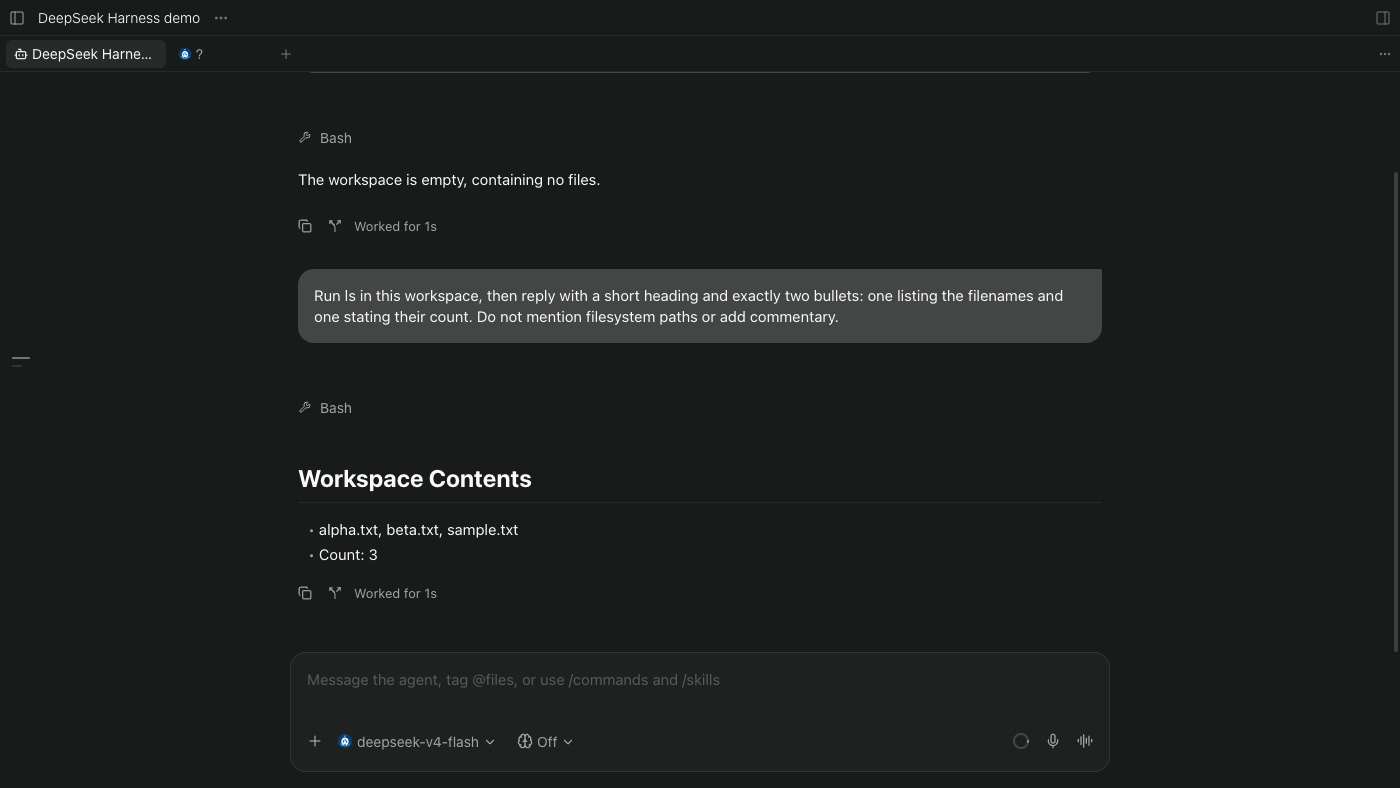
DeepSeek Harness adds a provider to Paseo so you can start agents that run through the official DeepSeek Harness command line tool (dsh) on the daemon machine. Paseo shows the conversation in its normal agent view, and the plugin has no screens of its own. It is a community plugin, not an official DeepSeek or Paseo product.
DeepSeek Harness must already be installed, logged in and configured on the daemon machine, with dsh on the daemon's PATH or set through Paseo's provider command override. The provider shows as unavailable, with the reason, if dsh reports a version below 0.1.5-rc.1 or cannot be read. It also needs Paseo 0.11.0 or newer and Node.js 22.19.0 or newer on the daemon. DSH 0.2.2-rc.1 additionally requires Node.js 24.9.0 or newer to run its CLI, so the daemon's command must launch it with that runtime. The plugin does not install dsh or rewrite its configuration files. The model and reasoning-effort choices come from the models dsh reports, so they follow your DeepSeek Harness setup.
If you are upgrading from 0.1.0-beta.12 or earlier, note that the plugin no longer reads the DSH_PASEO_COMMAND and DSH_PASEO_PROFILE environment variables. Move those values into Paseo's provider command override, agents.providers.deepseek-harness.command in the daemon's config.json, as one array such as ["/opt/dsh/bin/dsh", "--profile", "acp"]. The array replaces the whole default command, so keep a --profile that speaks ACP.
The Usage panel shows your DeepSeek API balance. To get it, the plugin reads the API key the same way dsh does, from the environment, ~/.dsh/.credentials.yaml or ~/.dsh/.env, and sends it only to DeepSeek's balance endpoint.
Each agent session runs dsh --profile acp as a child process under your operating system user, with the daemon's environment plus the session's environment variables. Any credentials in that environment reach dsh, and the plugin adds no sandbox or permission policy of its own. dsh itself makes the calls to DeepSeek's service.
Resuming a session asks dsh to restore its own context. If that fails, the plugin reports the error and does not start a new session. On Paseo 0.13+, the plugin can restore text history after an agent reload or daemon restart by reading DSH’s v4 session log under the session’s DSH_HOME. Context compaction preserves original messages and full tool results; correlated internal summaries and replacements are omitted. Repeated prefix compaction is supported even when replacement sequence numbers decrease. Missing, corrupt, unsupported or oversized logs leave the timeline empty without preventing context restoration. When history recovery was requested, one brief warning explains why it could not be displayed. Successful or empty history recovery is silent; the warning contains no transcript, paths or credentials. Beta.19 skips recorded model/reasoning selections as bookkeeping, including those emitted by DSH 0.2.2-rc.1. Replay is limited to one second, 16 MiB compressed and 64 MiB decoded; attachments and unrecognised surface replacements are not replayed. Provider slash commands, steering and plans are not supported, and Paseo's extra system prompt is not passed to dsh. Listing models can leave empty sessions in the dsh session list.
Images work through DSH's ACP interface when the model supports them. The plugin corrects a stale official ACP startup default found in DSH 0.2.1-rc.5 and still present in 0.2.2-rc.1, so a new default-config session can receive pictures without editing a profile. It reads DSH's public configuration dump and applies a temporary process-only overlay when the known mismatch is present; it keeps other ACP settings and removes the overlay on close. Different custom routes are unchanged, and the plugin does not claim image support for text-only models. Image attachments are not replayed from history.
Its automated checks pass with the Paseo 0.11.4 and 0.15.3 SDKs. With SDK 0.15.3, the production provider also initialized official DSH 0.2.2-rc.1, listed sessions and models, and reopened a persisted session in a fresh process without model calls. The beta.19 tarball also loaded as running on an isolated 0.15.3 daemon, with provider diagnostic Ready and model/reasoning discovery passing without model calls. Its 0.15.3 UI was not tested. Real turns ran on Paseo 0.11.4, 0.12.0-beta.2, 0.13.0, 0.13.2 and 0.14.0 daemons on macOS, most recently with DSH 0.2.1-rc.5. Windows and native iOS and Android clients are untested.